
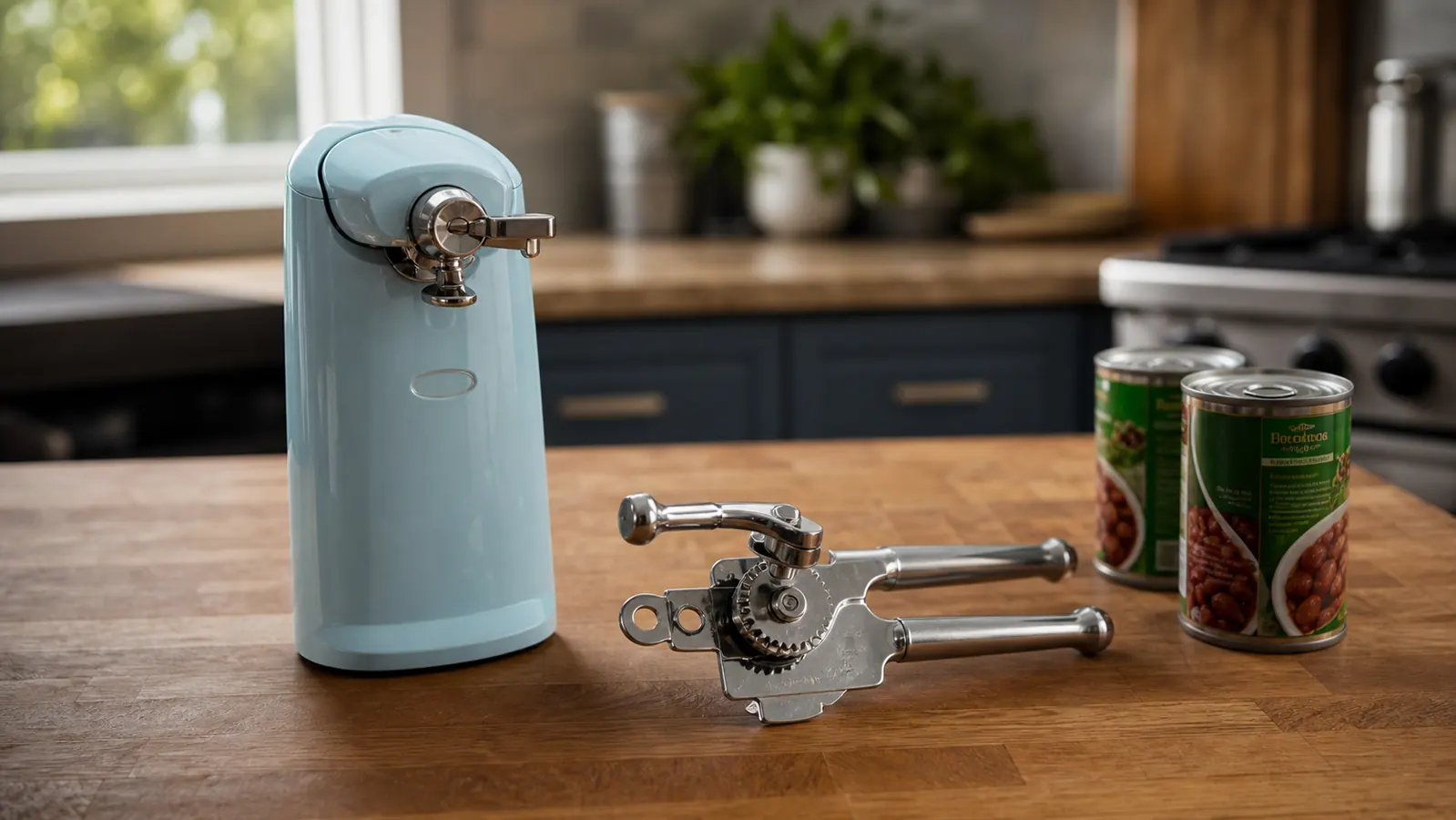
Short answer up front, since I know most people skimming this just want the verdict: if you go through five or six cans a week the way my kitchen does between beans, broth, and canned tomatoes, or if anyone in your house has a wrist or grip problem, the Kitchen Mama Auto Electric Can Opener earns the counter space. If you open a couple of cans a month and don't want one more gadget taking up room, a plain manual crank opener still does the job fine, and I'd tell you to save the drawer space rather than buy the electric one.
I'm not comparing these from a five minute store demo. I've had the Kitchen Mama on my counter for months of regular weeknight cooking, and I still keep a basic manual opener, the kind of plain stainless crank opener you'd find in the same aisle as the OXO Good Grips Smooth-Edge model, in the drawer as a backup for camping trips and the rare can the electric one can't grip. This is a comparison built from actually using both side by side in the same kitchen, not a spec sheet argument written from a product listing.
To keep it fair, I timed both openers on the same batch of cans over a couple of weeks, standard 15-ounce cans of beans and diced tomatoes, plus a few dented discount cans I keep on hand for exactly this kind of test. I also asked Walt, my neighbor who has limited grip strength in one hand, to try both so this wasn't just my own able-handed opinion driving the verdict.
What I mean by "earns the drawer space" is simple: does the tool get used, or does it end up shoved to the back of a cabinet after the novelty wears off? I've owned gadgets that looked great in a review and then sat untouched for a year, so the real test for both of these openers was whether either one lost its spot in daily rotation once the first-week excitement faded.
| What Matters | Kitchen Mama Auto Electric | Manual Crank Opener |
|---|---|---|
| Operation | Hands-free, one button press starts and finishes the whole cut | You turn the handle the entire way around by hand |
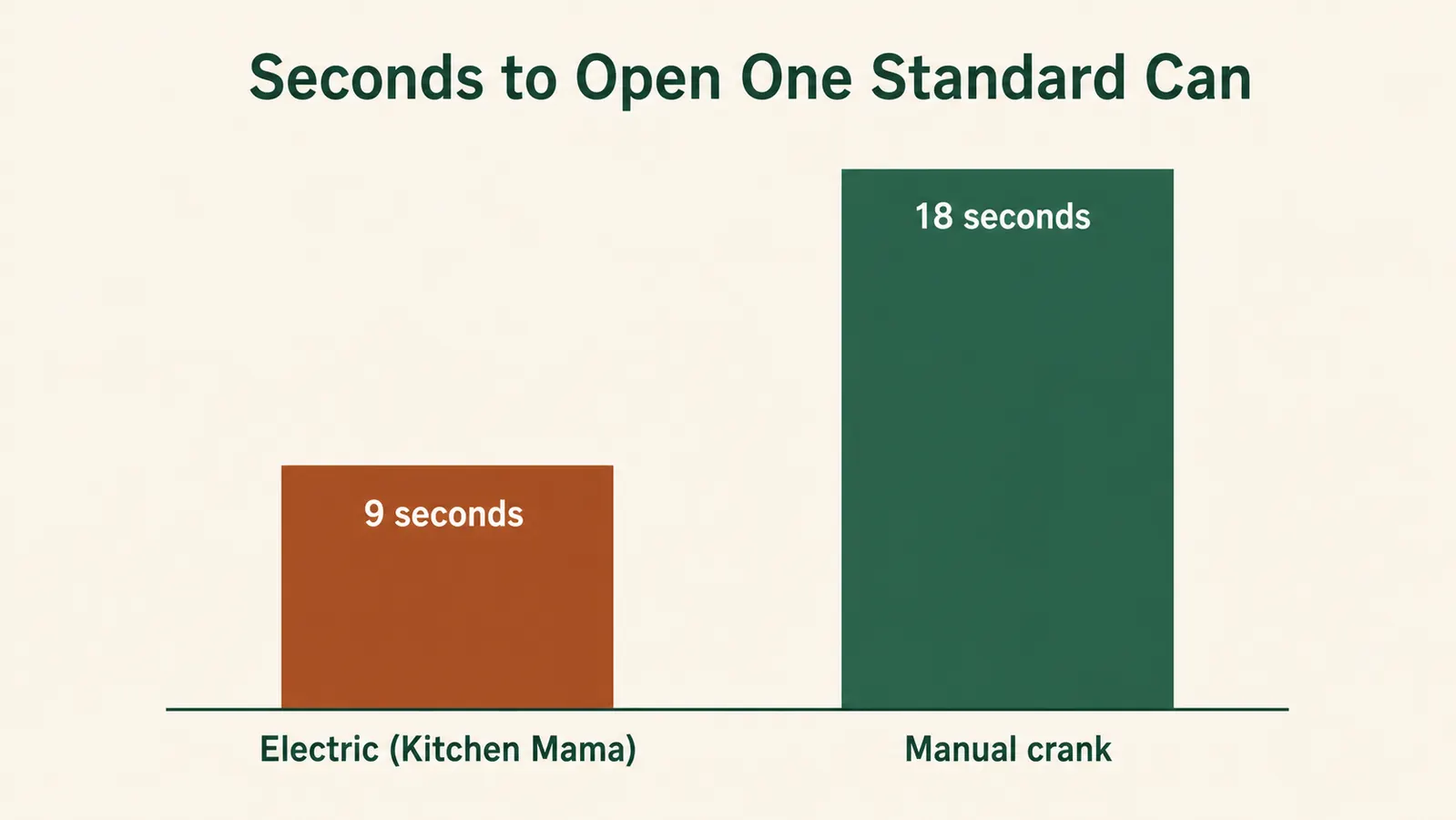
| Time on a standard can | About 9 seconds from clamp to lid off | About 15 to 20 seconds with a steady grip |
| Grip or wrist strain | None, no twisting motion at all | Real strain if you have arthritis or a weak wrist |
| Edge left on the lid | Smooth, rounded edge, no sharp lip to catch a finger | Sharp edge unless it's a smooth-edge model specifically |
| Power source | 4 AAA batteries, roughly 45 to 50 cans per set before a swap | None needed, works the same on day one and year ten |
| Counter or drawer footprint | Bigger, needs a fixed spot on the counter or a deep drawer slot | Flat and compact, fits in a thin utensil drawer |
| Cleaning | Wipe-down only, the motor housing can't get wet | Fully rinseable, dishwasher-safe on most models |
| Noise | A loud beep when the cut finishes | Silent except for the crank turning |
Where the Kitchen Mama Wins
The whole reason I bought the electric version was Walt. He's in his early 60s and had carpal tunnel surgery on his right hand two years ago, and he used to avoid buying canned goods entirely because a manual opener left his hand aching for an hour afterward. I let him try the Kitchen Mama on a can of chili one evening, and he bought his own the next week. That's the case for the electric model in one sentence, it removes the twisting motion completely instead of just making the twisting easier.
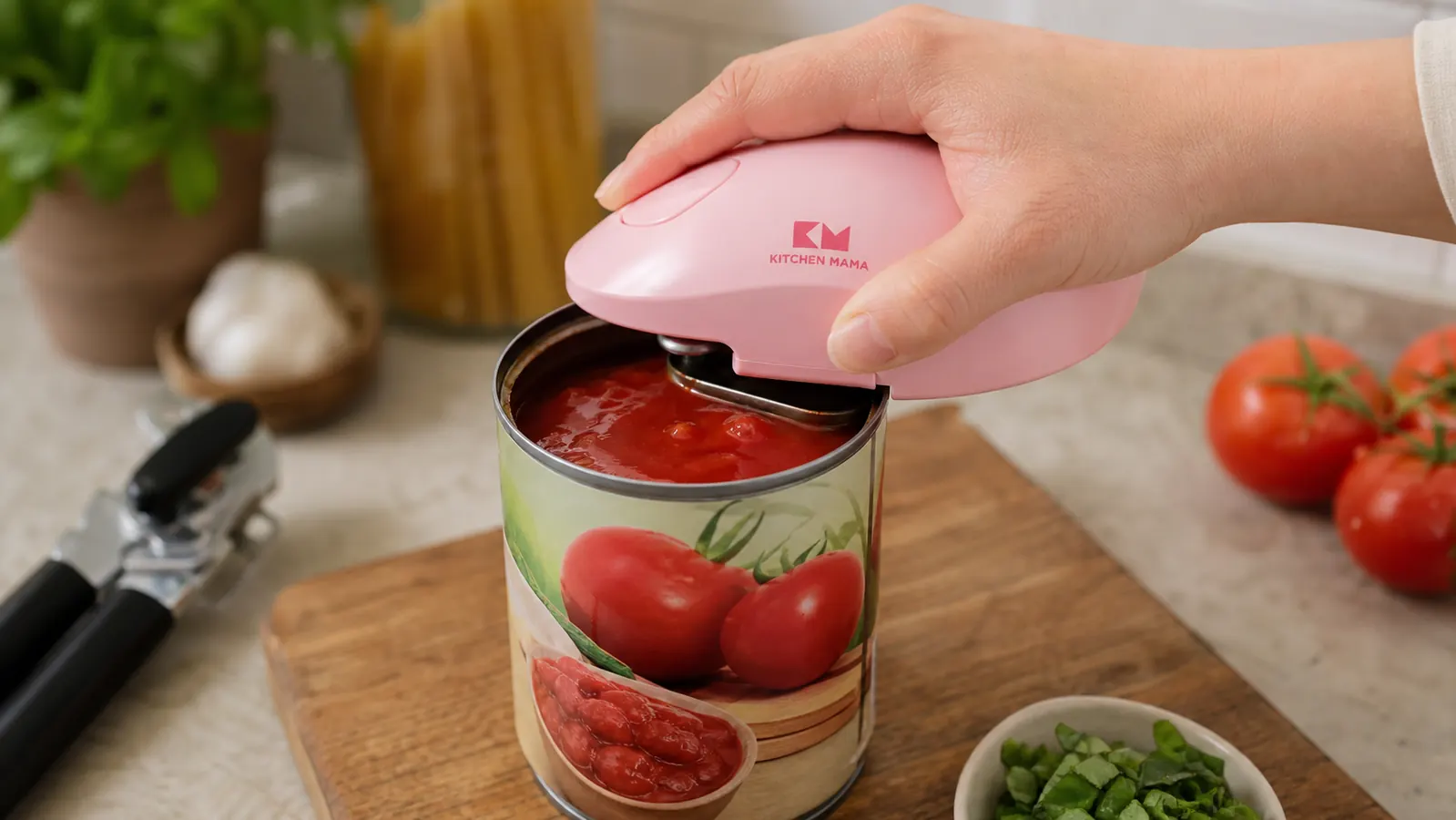
It's also just faster when your hands are already busy. I clamp it onto a can of black beans, press the button, and go back to stirring a pot while it finishes on its own, which takes about 9 seconds start to beep. With a manual opener you're locked into holding and turning for the full rotation, which is closer to 15 to 20 seconds and needs your full attention. I go through more of the day-to-day mechanics of that time savings, plus how it holds up after months of use, in my full long-term review of this model.
The edge quality has stayed consistent for me too, which matters more than it sounds. A dull or nicked manual opener starts leaving a ragged, sharp lip on the lid after a couple of years of use, and I've cut a knuckle on exactly that kind of edge before. The Kitchen Mama's cut has stayed smooth and rounded across every can I've run through it, because the mechanism doesn't rely on a blade wearing down evenly the way a manual crank's wheel does.
The magnet is a small detail that adds up over hundreds of uses. Once the Kitchen Mama finishes cutting, the lid stays stuck to the opener's magnet instead of dropping into the can or the sink, so you're not fishing a sharp disc out of tomato juice or bean liquid. With a manual opener, the lid either falls into the food or you're holding it with your fingers while it's still wet, and I've nicked a finger on that exact moment more than once over the years.
Where the Manual Opener Wins
The manual opener wins the moment batteries or storage matter more than speed. There's no battery drawer to keep stocked, no motor to eventually wear out, and no button to press, it just works the same on day one as it does ten years later. I've had my backup manual opener since before I owned a car, and it still cuts a clean enough edge on a normal can with zero maintenance beyond an occasional rinse.
It also wins on space by a wide margin. A manual opener is flat enough to tuck into a thin utensil drawer alongside your measuring spoons, where the Kitchen Mama needs a real footprint of its own on the counter or a dedicated drawer slot. If your kitchen is genuinely tight on room, or you're outfitting a small apartment or a camper where every inch of drawer space counts, a manual opener is the more sensible tool. I cover a few more honest tradeoffs like this, including the cases where I still reach for the manual backup myself, in my full honest review of the electric model.
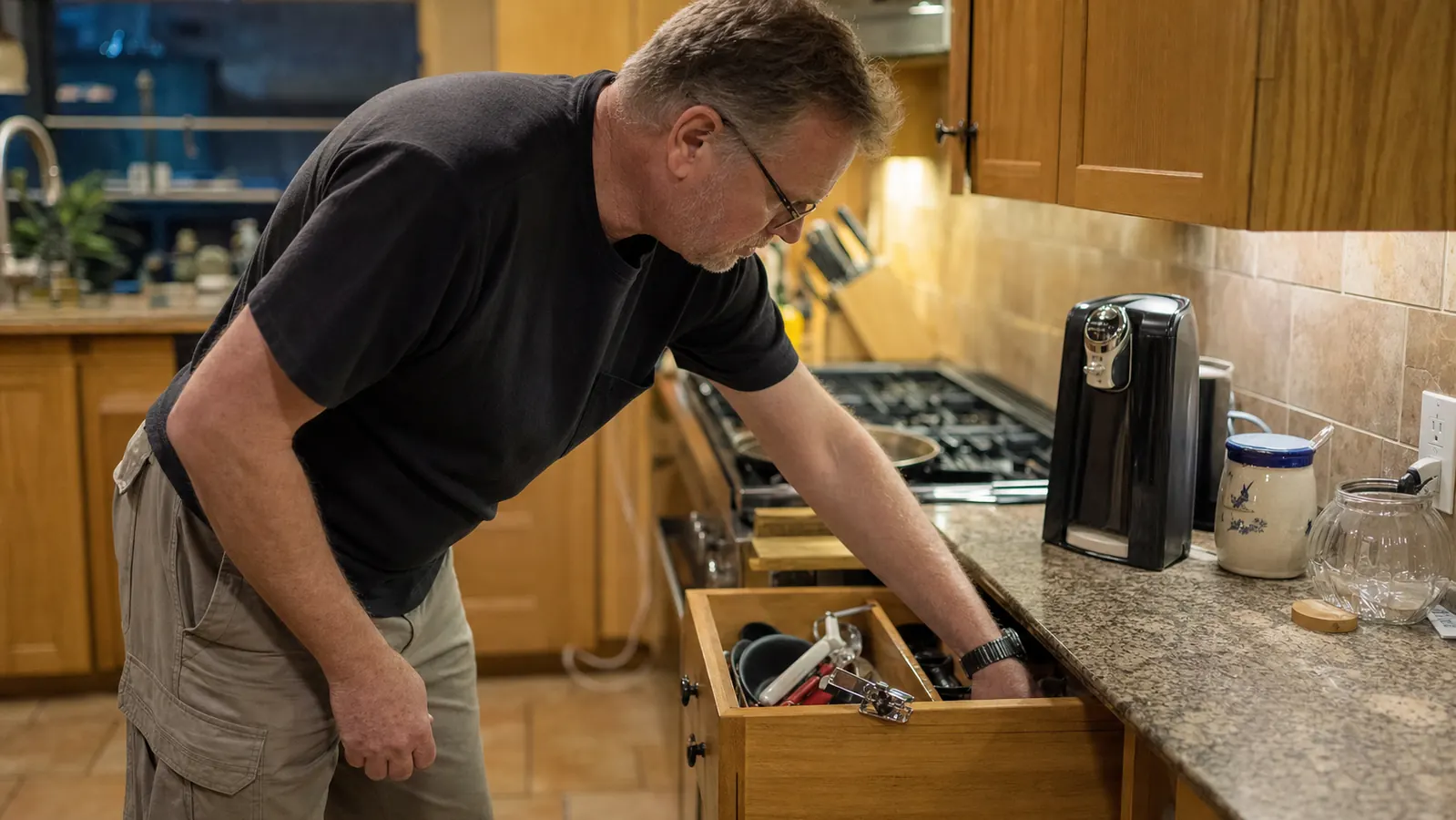
There's also a reliability angle that's easy to overlook until it happens to you. My batteries in the Kitchen Mama died mid-recipe once, on a Tuesday when I hadn't checked the spare pack in a while, and I had to finish that one can with the manual opener anyway. If your power goes out, or you're somewhere without a battery on hand, a manual opener never leaves you stuck. That's a small but real reason it stays in my drawer instead of getting donated.
Where It Comes Down to the Can
Standard, smooth-sided cans, the kind you get from beans, broth, and tomatoes, are where the Kitchen Mama pulls ahead clearly. It clamps evenly, finishes in seconds, and doesn't ask anything of your hand beyond the initial press. This is the case for probably 90 percent of what most people open in a normal week, so for most kitchens this is where the comparison actually gets decided.
Dented discount cans flip the advantage back toward the manual opener, in my experience. A crank lets you feel the resistance and adjust pressure by hand as you work around a dent, where the electric opener has stalled partway through a rotation on my dented test cans two or three times. When that happens, I finish the last inch with the manual opener anyway, so if your household regularly buys marked-down dented cans, keeping a manual backup in the drawer isn't optional, it's the only way to guarantee you can always get a can open.
Tall cans and short, squat cans are a smaller wrinkle worth mentioning. Tall 28-ounce cans, the big ones I buy for a double batch of sauce, work fine with the electric opener as long as the can sits flat and stable on the counter first. Short cans like tuna or cat food give the clamp less rim to grip, and I've had it slip and need repositioning once or twice. A manual opener handles both of those shapes about the same regardless of height, since you're steering it by hand the whole way around.
Ongoing Cost and Cleanup
A manual opener has no ongoing cost at all beyond replacing it if it eventually dulls or rusts, which for a decent stainless model can take years. The electric version does ask a little more of you long-term, a fresh set of AAA batteries every six weeks or so of regular use, plus keeping a spare pack on hand so you're not caught mid-recipe. It's a small recurring chore, but it is a chore the manual opener simply doesn't have.
Cleanup tips the other way. A manual opener can go straight into the dishwasher or get scrubbed under running water without a second thought, which matters if your household is heavy on canned tomatoes or anything sticky. The Kitchen Mama can't get its motor housing wet, so it's a wipe-down job with a damp cloth after use, maybe once a week if you're cooking with it daily. Neither routine is hard, but if dishwasher-everything is how your kitchen runs, that's worth knowing before you buy.
If a bad wrist or a busy weeknight has made can day harder than it should be, this is the one that actually removes the twisting.
The Kitchen Mama is the hands-free pick from this comparison. Check today's price and current availability before you decide.
Amazon Check Today's Price on Amazon →Who Should Buy Which
Buy the electric opener if anyone in your household has arthritis, a weak grip, or a wrist injury, or if you cook with canned goods often enough that the daily wear on your hand actually adds up over a month. It's also the better pick if you tend to cook with your hands full, stirring one pot while something else needs attention, since it works unattended once it's clamped on. Buy or keep a manual opener if you open a can once or twice a month, you're short on kitchen storage, or you want a backup that never needs batteries and can go in a camping bag without a second thought.
In my own kitchen the answer ended up being both, and I don't think that's a cop-out answer, it's just how the two tools actually get used differently. The electric one lives on the counter for daily use and handles almost everything I open in a normal week. The manual one rides along in the pantry for the rare dead-battery moment, the dented can, or the camping trip where I don't want to pack a battery supply. If you can only own one, though, weigh how often you cook with cans against how much drawer space you're willing to give up, and let that decide it.
For everyday cans, the hands-free version is the one that stayed out on my counter, not buried in a drawer.
See today's price and current reviews before you decide if it's the right fit for your kitchen.
Amazon Check Today's Price on Amazon →