

I already told the glowing version of this story. That other piece reads like a love letter to this exact opener, and mostly it earns it, but it was written from one can a day, spread across a normal week. This one is different. I bought a second Kitchen Mama automatic electric can opener four months ago specifically for my Sunday meal-prep kitchen, where I open somewhere between fifteen and twenty-five cans in a single two-hour stretch: black beans, pinto beans, diced tomatoes, coconut milk for curry, pumpkin puree in the fall, tuna for the kids' Monday lunches. Running it in continuous bursts instead of one can here and there surfaced things a daily-use review never catches, and none of it shows up in the Amazon listing photos.
This is the version with the parts I'd have wanted to know before buying a second one: what actually happens to the battery when you're not spacing the cans out, why the box calling it "hands free" is only half true, and why it never made it into my utensil drawer. None of it makes me want to send it back. But if you're picturing the same experience you saw in the five-star reviews, you deserve the fuller picture first.
The Quick Verdict
A genuinely useful opener for batch cooking, but the hands-free claim, the battery life, and the storage footprint are all a little more work than the listing lets on.
Amazon Check Today's Price →Before you add this to a cart based on the star rating alone, get the honest version of what a big cooking day actually looks like with it.
Check today's price and current availability, then read what a full batch-cooking session actually asks of it.
Amazon Check Today's Price on Amazon →Why I'm Writing the Honest Version
The unit I'm writing about here isn't the one from my long-term piece. I already wrote the enthusiastic, this-thing-earned-its-spot review about the original opener in my main kitchen, and I stand by it. This is a second Kitchen Mama I bought in the spring specifically for meal-prep Sundays, where I cook most of the week's lunches and dinners in one sitting so the rest of the week is just reheating. That means the opener isn't getting used once or twice a day like a normal kitchen. It's getting run fifteen, twenty, sometimes twenty-five times back to back, with maybe ninety seconds between cans while I'm draining or measuring the last one.
That's a genuinely different test than most reviews run, including my own first one. A once-a-day opener has time to sit and cool between uses, and the batteries get a rest. A batch session doesn't give it either of those things, and four months of Sundays with this exact unit taught me a few things I wouldn't have guessed from the box.
I want to be upfront that this isn't a takedown. It's still on my counter every Sunday and I haven't gone back to a manual opener for the meal-prep kitchen. But "honest" means telling you about the parts that surprised me, not just the parts that made the sale easy.
The two units aren't identical in wear, either, which surprised me. The original opener in my other kitchen has logged roughly a can a day for a year and a half and still runs smooth. This second Kitchen Mama, four months old, has already got a faint rattle in the clamp arm at the start of a rotation that the older one never developed, even though it's seen far fewer total cans. My guess is that it's not total can count that wears these things, it's how much continuous strain the motor takes in a single sitting, which is exactly the kind of detail you'd only notice if you were running two of the same opener side by side under different conditions.
The "Hands-Free" Claim, Tested on Wobbly Cans
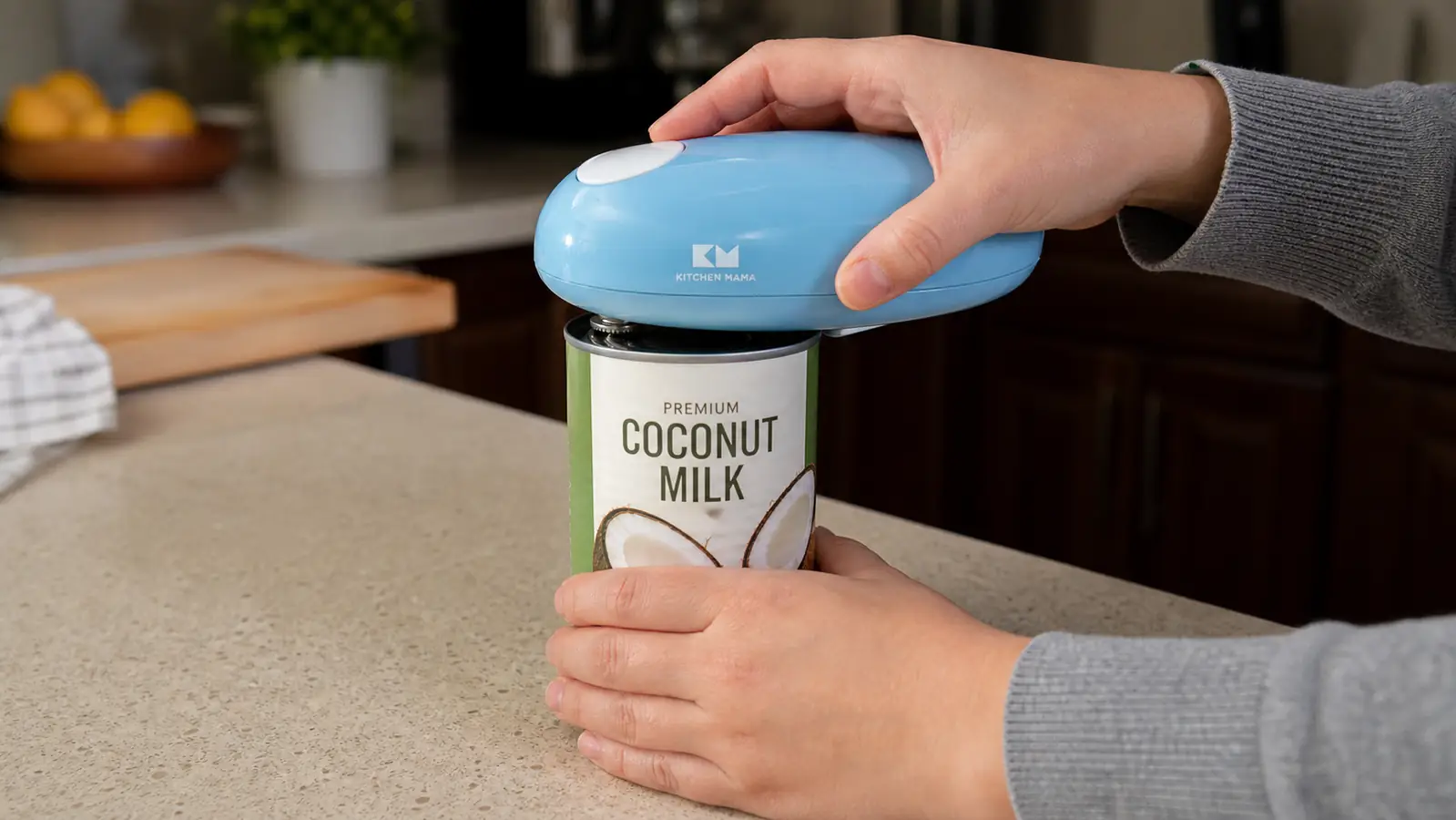
On a standard can of beans or diced tomatoes, sitting flat and full, hands-free is basically accurate. You set it, press the button, and walk away to stir something else. That part of the marketing holds up fine, and it's the scenario every demo video shows you.
Where it stops being fully hands-free is on anything tall, light, or already partway open. Tall coconut milk cans and slim pineapple juice cans are narrow enough that the clamp can rock the can slightly as it rotates, and on a can that's mostly empty, that rocking is enough to tip it if you actually walk away. I learned this the hard way with curry night, coconut milk sprayed across the counter because I trusted the name on the box more than I should have. Now I keep one hand loosely on any tall or light can while it runs, which defeats the whole point a little. It's not a dangerous flaw, just a gap between the marketing and the reality on anything that isn't a standard squat can.
Cans that are already dented or slightly out of round have the same issue for a different reason: the clamp doesn't seat evenly, so the whole unit can shift mid-rotation instead of the can tipping. Between the wobble on light cans and the shift on dented ones, I'd guess about one in eight cans in a typical batch session needs my hand nearby, not fully hands-off like the box implies.
I've also noticed the clamp grips less confidently on cans with a paper label still fully wrapped around the rim, since the extra layer changes the exact diameter it's expecting. Peeling the label back an inch before setting the opener down fixed it every time, but it's an extra step the box never mentions, and it's easy to miss the first few times when you're moving fast through a stack of cans.
The Battery Math Nobody Puts on the Listing Page
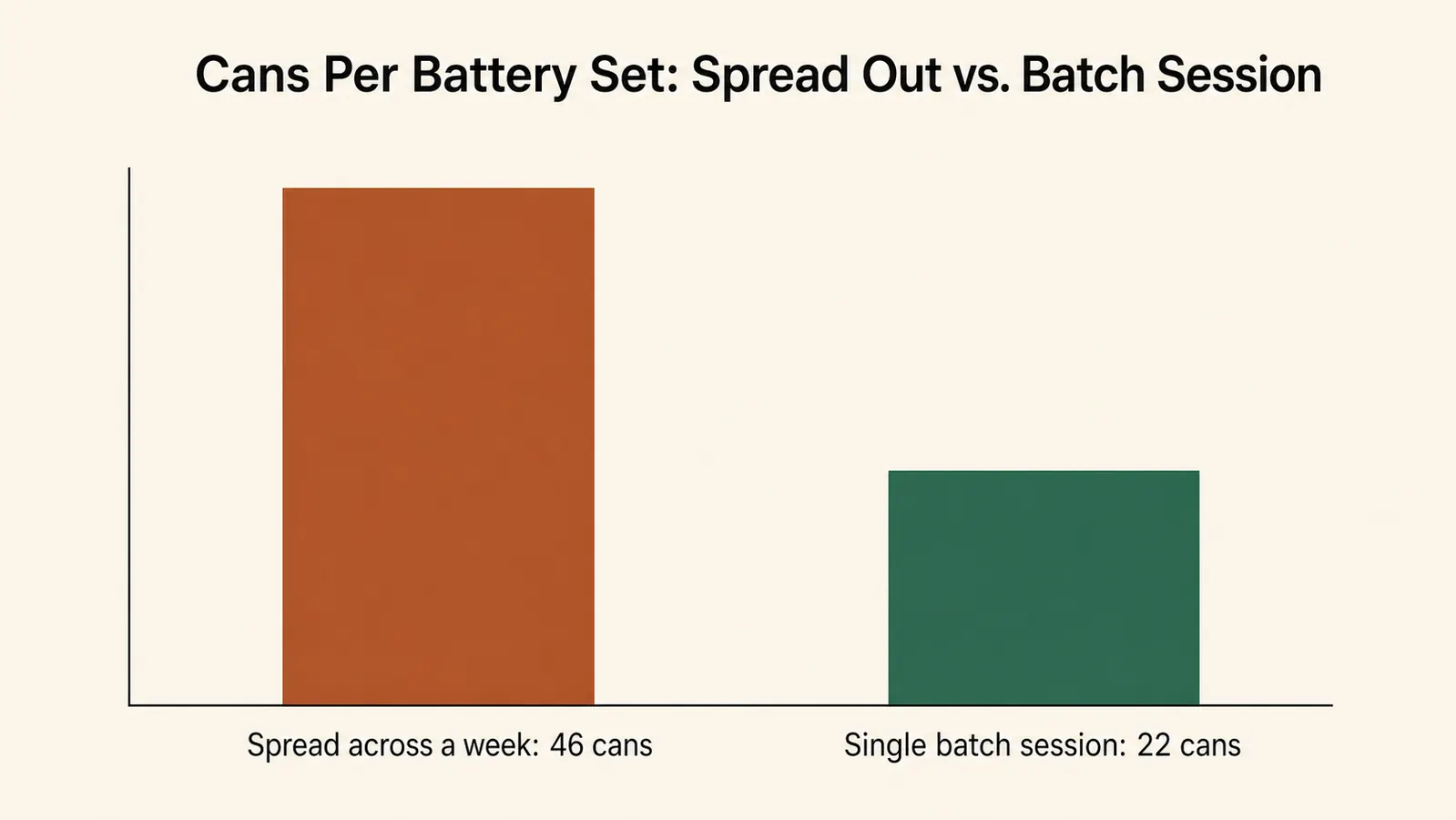
Every review I read before buying, including my own first one, talks about battery life in terms of total cans per set, somewhere in the forties. That number is true, but it assumes the cans are spread out over days or weeks with rest in between. Batch cooking doesn't work that way, and the motor pays for it.
Across four months of Sunday sessions, a fresh set of four AAA batteries has consistently gotten me through about twenty-two cans in one continuous sitting before the motor starts to slow down and strain audibly on the last few rotations, even though the same battery set would likely have handled closer to double that spread across a normal week. The chart above shows both numbers side by side, and the gap is bigger than I expected going in. Running the motor back to back without the rest a spread-out week gives it seems to drain the batteries meaningfully faster.
In practice, this means I now buy batteries in bulk and swap a fresh set at the start of every Sunday session out of habit, rather than waiting for it to slow down mid-can. It's a small extra step, but it's a real ongoing cost that the per-can battery math on most listings doesn't account for if your kitchen does things in bursts instead of trickles.
I've also started keeping the receipts, in a manner of speaking. Rechargeable AAAs looked like the obvious fix, so I tried a set of decent rechargeables for two Sundays running. They worked, but the voltage curve on rechargeables drops off faster near the end of the charge than alkaline batteries do, so the opener slowed down noticeably around can eighteen instead of holding steady closer to can twenty-two. For a batch-cooking kitchen specifically, I've gone back to fresh alkaline sets every Sunday, even though it feels wasteful, because a mid-session slowdown on a Sunday with three kids waiting for lunch is worse than the extra cost of batteries.
Noise and Heat You Don't Expect From the Product Photos
Nobody photographs a can opener getting warm, but after eight or ten cans in a row, the motor housing is noticeably warm to the touch, warm enough that I now let it sit for a minute or two after a long run before I put it away. It's never felt unsafe, and it's never shut itself off or shown any sign of real strain, but it's a detail that only shows up under batch use and never comes up in a normal one-can-a-day review.
The completion beep is the other thing that only becomes a real issue at volume. My partner works from home most Sundays, and after the third or fourth beep interrupting a video call from the next room over, she asked, only half joking, if I could do meal prep on a different day. One beep is a mildly loud chirp. Twenty of them in ninety minutes is a pattern the whole house notices, and it's worth knowing about if anyone in your home works or takes calls nearby while you cook.
I tried muffling it by opening cans over a folded dish towel, thinking it would dampen the beep the way it dampens a dropped pan, but the sound comes from inside the housing itself, not from the can hitting the counter, so the towel did nothing. The only real fix I've found is timing the noisier stretch of prep around the calls I know are coming, which isn't a huge ask, just another thing I wish the listing had flagged instead of leaving me to figure out.
Storage: It Doesn't Fit Where You Think It Will
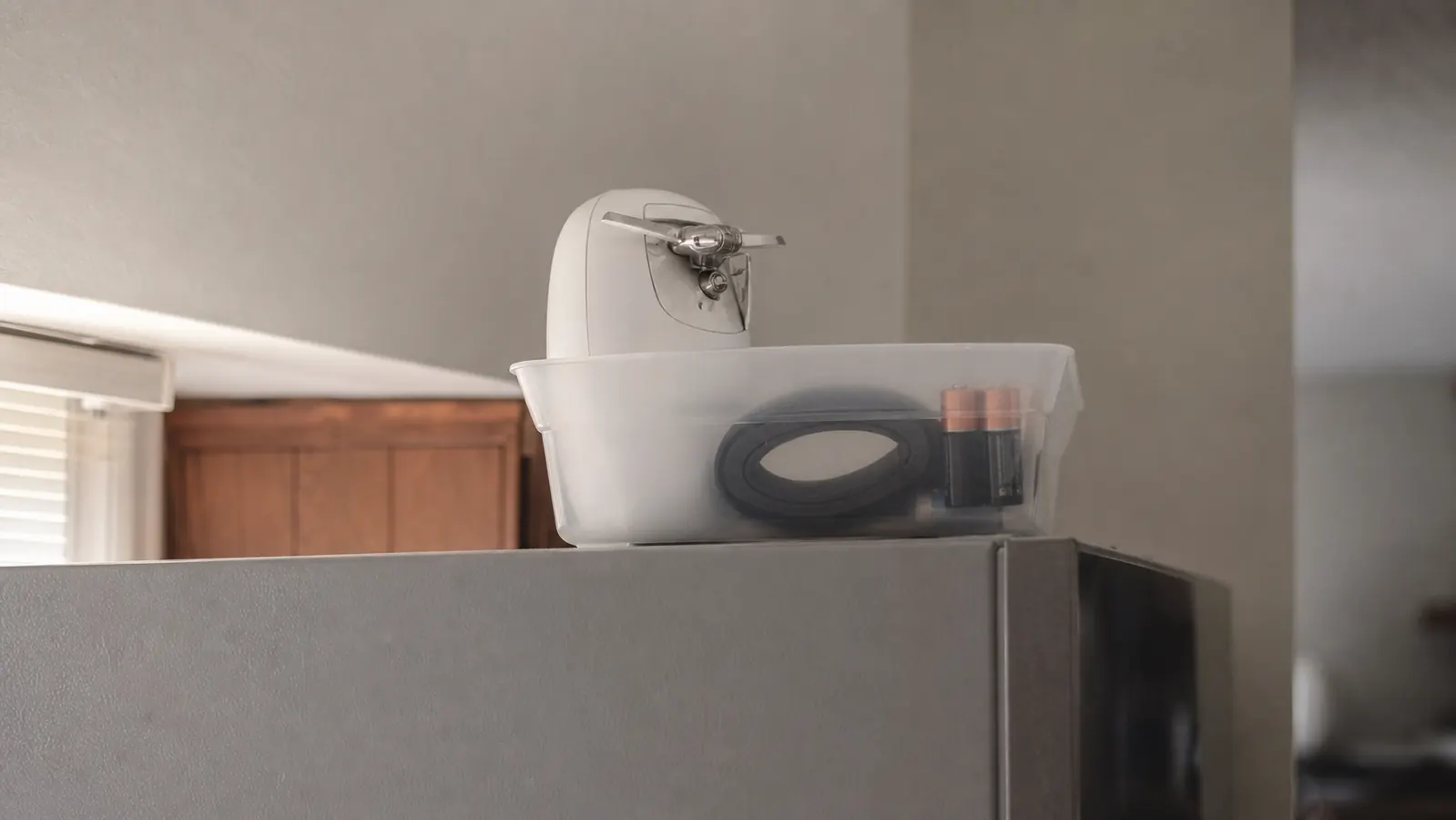
The listing photos show it sitting neatly on a counter or tucked in a drawer next to flatware, and I assumed it would slide right into my utensil drawer the way a manual opener always had. It doesn't. The clamp arm and the rounded base together are wider and taller than a typical drawer divider slot, and mine kept catching on the drawer above it every time I tried to close it flat.
I ended up giving it its own small bin on top of the refrigerator, along with a spare set of batteries and the little rubber gasket that came in the box. It works fine there, but it's one more thing claiming counter-adjacent real estate in a kitchen that was already tight before this arrived, and it's a very different picture than the tidy drawer shot on the product page. If drawer space is the whole reason you're considering an electric opener over a manual one, it's worth reading this side-by-side comparison on size and storage before you assume it'll simply replace what you already have space for.
There's a smaller storage wrinkle too: the charging-free design means there's no cord to coil up, which sounds like a pure win, but it also means there's nothing tethering it to one spot, so it tends to migrate. Between Sundays I've found it on the counter, in the bin, and once inside a cabinet where one of the kids put it away without asking. If you're someone who likes appliances to have one clear home, plan on designating that spot on purpose, because this one won't pick one for you.
What I Liked
- Genuinely saves the wrist on a big Sunday batch of fifteen or more cans
- Smooth cut edge leaves nothing sharp for little hands digging through the recycling bin
- Consistent grip and rotation on standard soup and bean cans every single time
- Wipes clean between different foods without dragging old residue into the next can
- Works straight out of the box with no charging wait before the first use
- Light enough that my ten-year-old can use it under supervision
Where It Falls Short
- Hands-free is only half true on tall, light, or dented cans, they still need a steadying hand
- Motor housing gets noticeably warm after eight to ten cans run back to back
- Burns through a battery set almost twice as fast in one continuous batch session versus spread-out daily use
- Doesn't fit a standard utensil drawer, ended up needing its own storage bin
- The completion beep is loud enough to interrupt a call in the next room during a long session
- No low-battery indicator, it just slows down and strains until you notice
The listing photos make it look like a set-it-and-forget-it gadget. Run it through a real batch-cooking Sunday and you'll find out it's more of a set-it-and-check-on-it-occasionally gadget, which is still a good trade, just not the exact one advertised.
Who This Is For
If you cook in batches, whether that's Sunday meal prep, a big pot of chili for a crowd, or canning-adjacent cooking that involves a dozen or more cans at once, this is still worth having, especially if wrist strain from a manual opener is part of why you're looking. Just go in expecting to keep an eye on it during a long run rather than walking away entirely, and keep a spare battery set on hand for the days you're going heavy.
It's also worth it if you're buying a second unit like I did, one for a main kitchen and one for a specific high-volume job, rather than trying to make a single opener do double duty across two very different use patterns. Splitting the load the way I have has kept both units running well past what I'd expect from a single opener carrying the full workload alone.
Who Should Skip It
If your kitchen storage is already tight and you were counting on this sliding into the same drawer slot as a manual opener, measure your drawer first or plan on giving it its own spot elsewhere. And if you're someone who cooks with a lot of light or oddly shaped cans, tall broths, juice cans, anything narrow and mostly empty, know that you'll still be hovering nearby more than the hands-free branding suggests, so a lot of the time-savings promise depends on what's actually in your pantry.
Still worth it for a big cooking day, just not the completely hands-off gadget the box promises.
See today's price and current reviews, then decide with the full picture instead of just the highlight reel.
Amazon Check Today's Price on Amazon →