
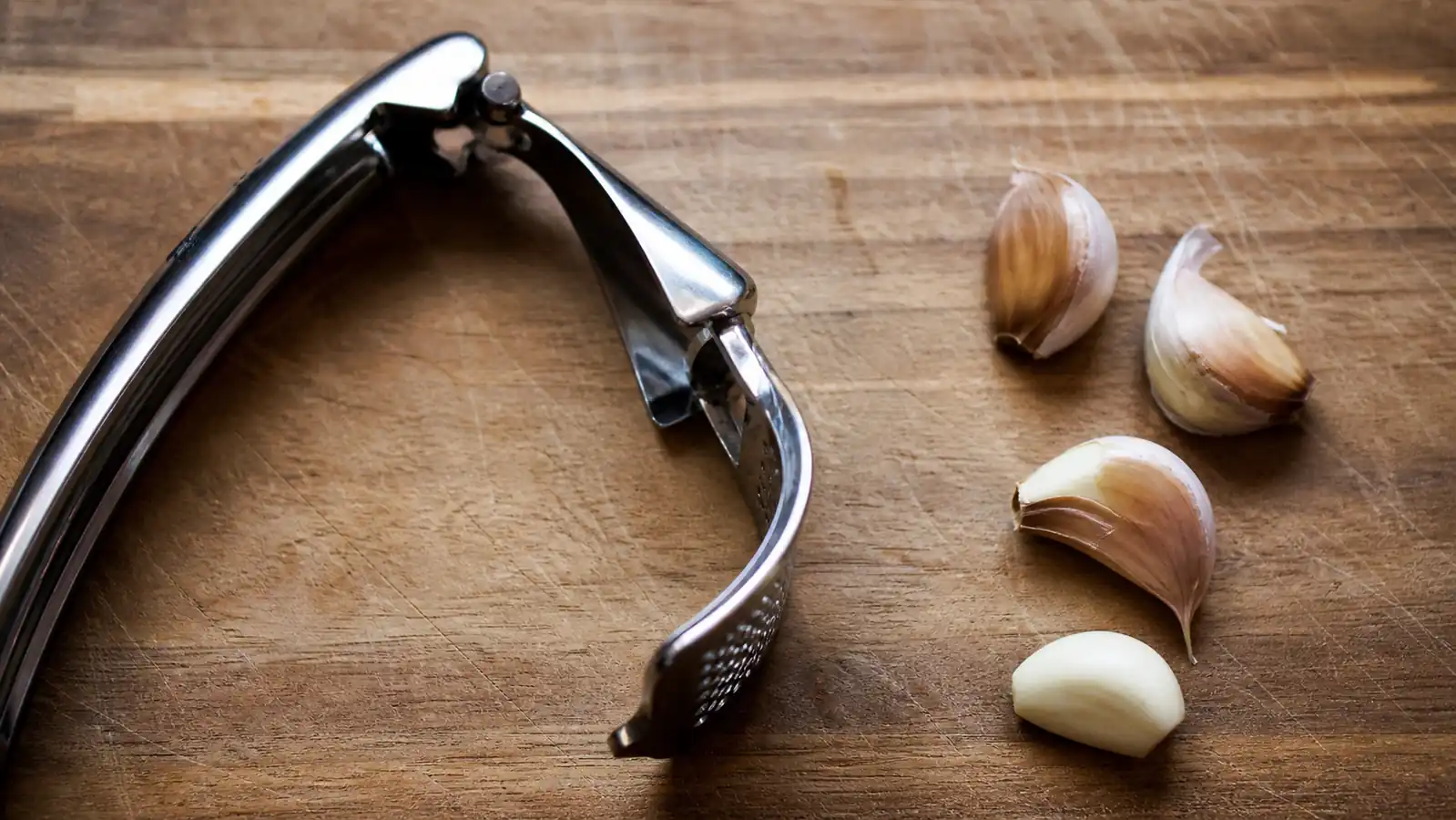
I bought the Vantic Garlic Press Rocker in July of last year after breaking my third squeeze-style press in as many years. I'd gotten used to the annual ritual: pick up whatever garlic press was closest at the store, watch the hinge crack or the holes gum up with fibrous pulp within a few months, then go buy another one. Thirteen months later, this stainless rocker is still the only garlic tool in my kitchen drawer, and it's the reason I stopped peeling cloves by hand on the nights I'm too tired to bother.
I cook most weeknights, usually for two, and garlic goes into more of those dinners than I'd admit if you asked me to count. Garlic butter shrimp, a quick tomato sauce, stir-fry, hummus on the weekends. That's roughly three to four uses a week since last July, which puts this press somewhere north of a hundred and fifty rounds of actual cloves, not showroom testing. Here's what a year of that looks like.
It also comes with two small extras I didn't expect to care about: a rubber peeler sleeve for getting the skin off a clove in a few rolls under your palm, and the silicone scraper I'll get to later. Neither is the reason I bought it, but a year in, the peeler sleeve is the piece I'd miss most if it went missing. It turns the slowest part of using any garlic press, the peeling, into something that takes about five seconds per clove.
The Quick Verdict
Faster and cleaner than a squeeze press, still needs a rinse every time, and the hinge has held up better than anything I've owned before it.
Amazon Check Today's Price →Tired of buying a new garlic press every year?
This one is still going strong after thirteen months of weeknight cooking. See today's price and current availability on Amazon.
Amazon Check Today's Price on Amazon →How I've Used It
My test wasn't a lab, it was a normal kitchen drawer. The Vantic lives next to my chef's knife and cutting board, and it comes out any time a recipe calls for more than one clove, which in my house is most of them. I never babied it. It's gone through the dishwasher, been left in a wet sink overnight more than once, and traveled to a rental kitchen on a week-long trip last October.
I didn't switch presses or run a side-by-side for most of the year, I just used it the way I'd use any tool I actually trust: without thinking about it. The comparison against my old OXO squeeze press and a chef's knife came later, once I wanted to know if the rocker style was actually faster or if I'd just gotten used to it.
One thing worth saying up front: this isn't a gadget that needs a learning curve. You set an unpeeled or peeled clove in the chamber, rock the handle down like a paper cutter, and minced garlic comes out the bottom holes. My first use was also my fastest use.
It also earned a permanent spot on the counter rather than tucked in the back of a drawer, which tells you something about how often it actually got used versus how often I meant to use it. Tools that need to be dug out tend to get skipped on a busy Tuesday, and this one didn't.
The Rocker Design, and Why It Beats the Squeeze Presses I Owned Before
Every garlic press I owned before this one was the squeeze-handle style, the kind where you clamp a clove into a small perforated basket and squeeze the two handles together like pliers. That design works fine for the first few months. Then garlic fiber starts packing into the holes, the hinge loosens, and eventually you're mashing your palm against the handles just to force a clove through.
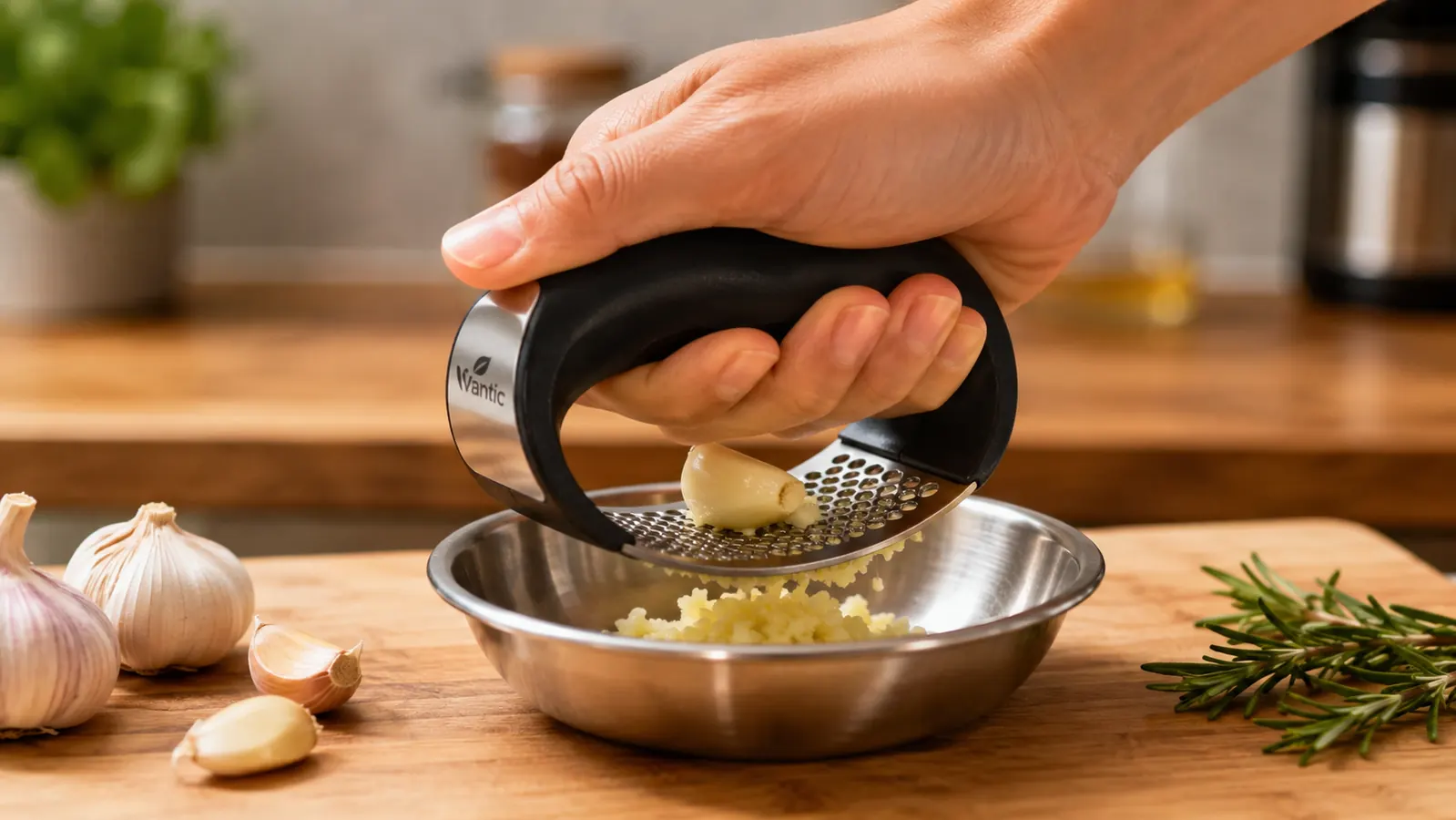
The rocker style is a different mechanism entirely. The garlic sits in a shallow stainless trough, and you press down on a hinged lid that rocks from one end to the other, forcing the clove through a row of holes as the lid travels across it. Because the motion is a rock instead of a squeeze, you're using your body weight and a lever, not hand strength. My husband, who has some grip weakness in his right hand from an old wrist injury, can use this one without wincing. He gave up on our old squeeze press entirely.
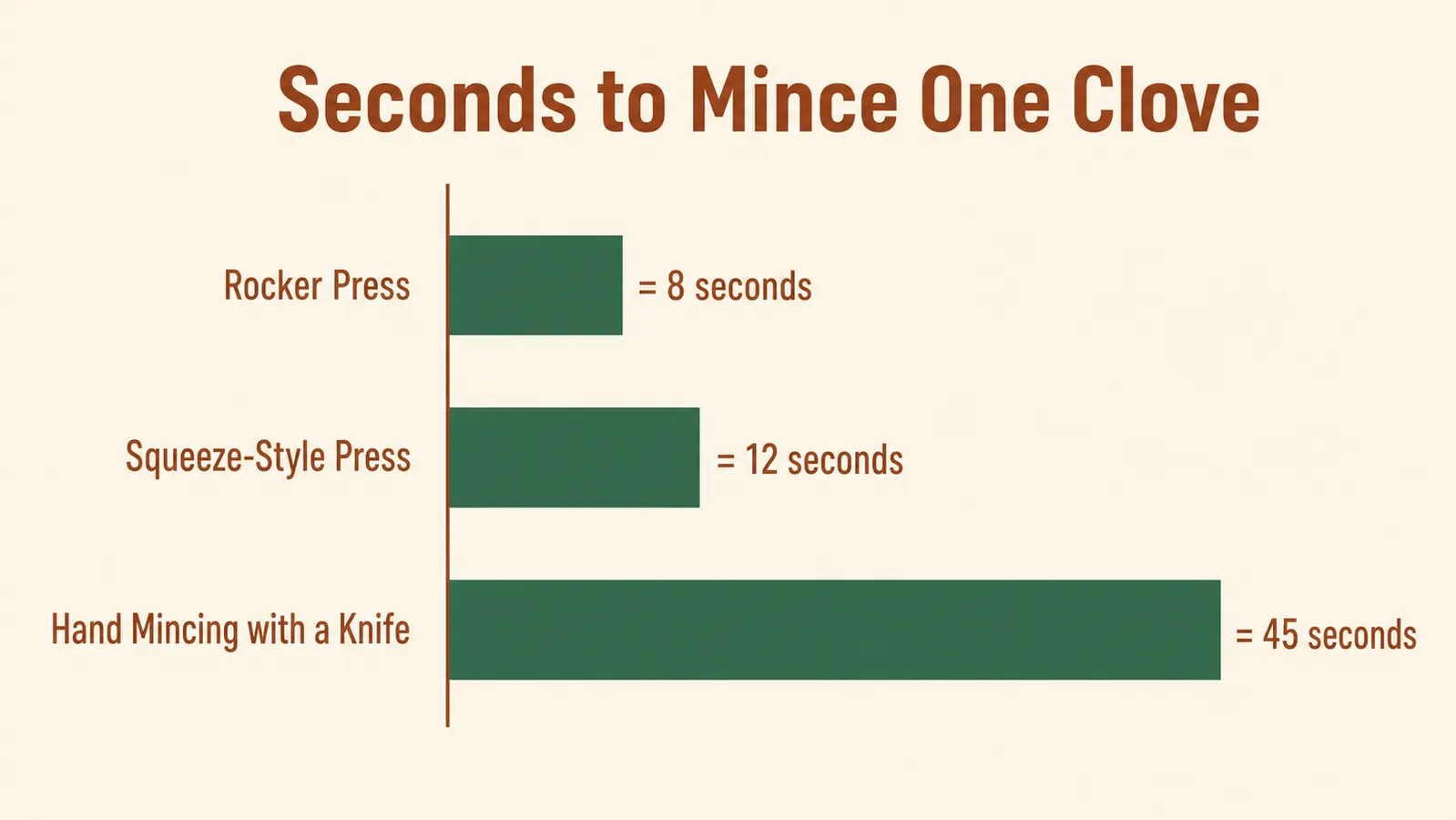
The stainless steel construction also matters more than I expected going in. My old plastic-handled presses developed hairline cracks near the hinge within a year. This one is solid stainless from the trough to the handle, and after thirteen months there's no flex, no wobble, and no rust despite regular dishwasher trips. I compared cutting a clove by hand versus running it through this Vantic for the chart above, and the rocker beat both the knife and my old squeeze press on speed by a wide margin.
The rubber peeler sleeve I mentioned earlier pairs with the press better than I expected. Instead of peeling with a knife or my fingernails, I roll an unpeeled clove inside the sleeve on the counter, the skin comes loose, and the clove goes straight into the press. It's a small step, but multiplied across a hundred and fifty cloves it's real time saved, and it's one less sticky-fingered moment mid-recipe.
A Year of Weeknight Dinners: What Actually Held Up
The honest test of a kitchen gadget isn't whether it works on day one, it's whether it still works when you've stopped being careful with it. By month four I'd stopped rinsing it immediately after use, sometimes letting minced garlic dry onto the holes overnight before I got back to the sink. That's exactly the scenario that killed my old presses, because dried garlic fiber is close to cement once it sets.
This one shrugged it off. A quick soak under hot water and a scrub with the included scraper tool, and the holes cleared out completely, even after sitting overnight. I never had a clog I couldn't clear in under a minute, which was not my experience with the plastic squeeze presses I'd used for the previous four years.
The hinge is the part I watched most closely, since that's where my old presses always failed first. At month thirteen it still rocks smoothly with no play side to side, and the pressure needed to push a clove through hasn't noticeably increased. I'd guess I've minced somewhere around 150 to 180 cloves through it over the year, and it feels the same as it did in August.
Corrosion was the other thing I kept an eye on, since I run it through the dishwasher more often than the box probably recommends. No pitting, no rust spots at the hinge pin, nothing beyond that slight dulling of the shine I mentioned already. I also stored it in a humid drawer near the sink for most of the winter without a liner, and it came out fine.
Cleanup and the Silicone Scraper That Comes With It
It ships with a small silicone scraper shaped to fit the holes, and I'll admit I almost lost it in a drawer in the first month and didn't think I'd miss it. I was wrong. Without it, clearing packed garlic out of the holes means fingernails or a toothpick, neither of which is fun to do three nights a week. With it, the whole cleanup takes maybe fifteen seconds.
It's labeled dishwasher safe and I've run it through ours regularly, usually on the top rack with the utensils. The finish has dulled slightly, less shine than it had new, but nothing that affects how it works. If I'm honest, hand-washing under hot water with the scraper takes about the same amount of time as loading it into the dishwasher, so I do a mix of both depending on how the rest of the sink looks that night.
The scraper also does double duty for the peeler sleeve, since it's flexible enough to push residual skin out of the rubber grooves. I keep both pieces clipped together in the same drawer compartment so I'm never hunting for one while the other is loaded with garlic.
What I Liked
- Rocker mechanism needs far less hand strength than a squeeze press
- Stainless steel body shows no cracking or wobble after 13 months
- Included scraper clears the holes in seconds, even on dried garlic
- Peeler sleeve turns peeling into a five-second step
- Works with peeled or unpeeled cloves
- Noticeably faster than mincing by hand for everyday recipes
Where It Falls Short
- Still requires a rinse after every use, it's not a walk-away tool
- Very small or oddly shaped cloves occasionally need a second push
- Basic handle shape, no cushioned grip for arthritis or severe hand pain
- One size chamber, not built for mincing large batches at once
It's not that this press is magic. It's that it's the first one I've owned that still works the same way in month thirteen as it did in week one.
Where It Falls Short
The chamber is sized for a single clove at a time, so if you're making a big batch of roasted garlic paste or cooking for a crowd, you'll be reloading it over and over rather than pressing a handful at once. For my everyday cooking that's a non-issue, but I wouldn't recommend it as your only tool if you regularly mince a full head of garlic in one go.
It also isn't fully hands-off. You still need to rinse it after use or the garlic will dry in place, and it's not something you can leave in the chamber and come back to the next day. The handle is functional stainless steel with no rubber or silicone grip, which is fine for most hands but won't be the most comfortable option if you deal with arthritis or significant hand pain. And once in a while a very small clove sits crooked in the trough and needs a second, firmer press to fully go through.

Alternatives I Considered Before Buying This One
Before I landed on the rocker style, I looked at a Microplane zester for mincing garlic, which produces an almost paste-like texture that's great for dressings but takes noticeably longer per clove and clogs with fiber fast. I also seriously considered just going back to a chef's knife, which I still use when a recipe calls for sliced or smashed garlic rather than minced. If you're weighing that exact tradeoff, I broke down the time and cleanup difference in more detail in garlic press versus mincing by hand.
I also want to be upfront that a garlic press isn't the only reason to own one of these. If you cook on a schedule like mine, where dinner has to happen in under thirty minutes most nights, the time savings add up in ways that aren't obvious from a single use. I laid out the specific reasons this ended up earning a permanent spot in my drawer in 10 reasons a garlic press saves time on busy weeknights.
Who This Is For
If you cook several nights a week and garlic shows up in most of your recipes, this is a genuinely useful upgrade over a squeeze press or a knife, especially if hand strength or grip is an issue for you or anyone else in your kitchen. It's also a good fit if you've been burned before by a cheap press that clogged or cracked within a year, since the stainless build has outlasted every plastic version I've owned. If peeling garlic is the part of the process you dread most, the included peeler sleeve alone makes it worth having in the drawer.
Who Should Skip It
If you cook in large batches, run a home kitchen that regularly processes a full head of garlic at once, or you already have solid knife skills and don't mind the extra minute mincing by hand takes, you probably won't notice enough of a difference to justify adding another single-use tool to your drawer. And if a dishwasher-and-forget tool is a hard requirement, this isn't quite that, since it still needs a rinse every time.
Still using a squeeze press that's on its last hinge?
This is the one I've reached for three to four nights a week for over a year without a single clog it couldn't clear. Check today's price on Amazon before your next grocery run.
Amazon Check Today's Price on Amazon →