
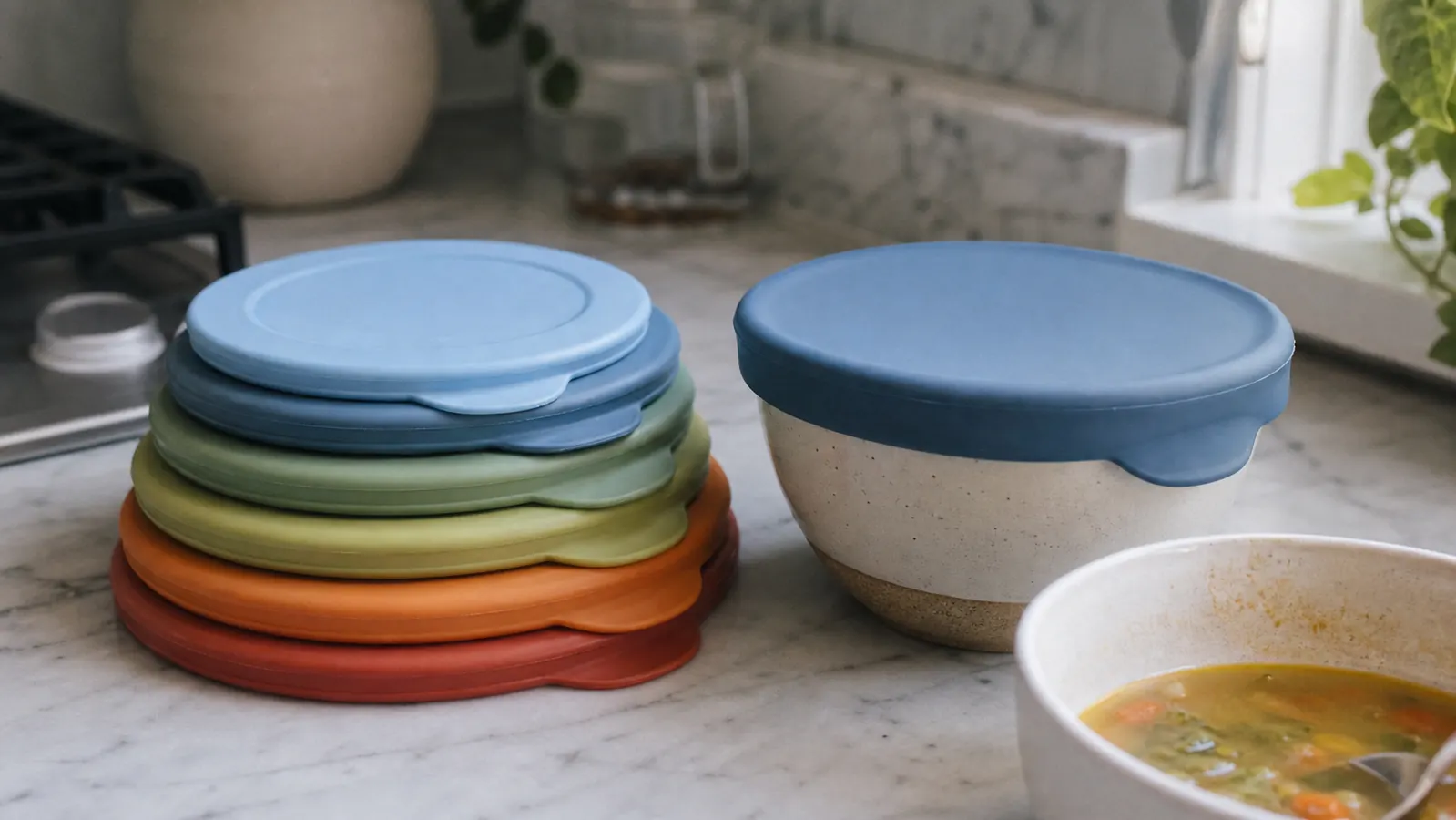
I bought the GUANCI 8-pack of silicone lids in July of last year because I was sick of digging through the plastic wrap drawer for a box that was always down to the last three feet, always torn at an angle, always sticking to itself before it made it anywhere near a bowl. My husband and I go through leftovers fast, chili on Sunday, half a rotisserie chicken on Tuesday, a bowl of cut cantaloupe that never lasts a full day in this house, and I was tired of the ritual of tearing off a sheet, smoothing it down, and watching it slide off the second the bowl went in the fridge.
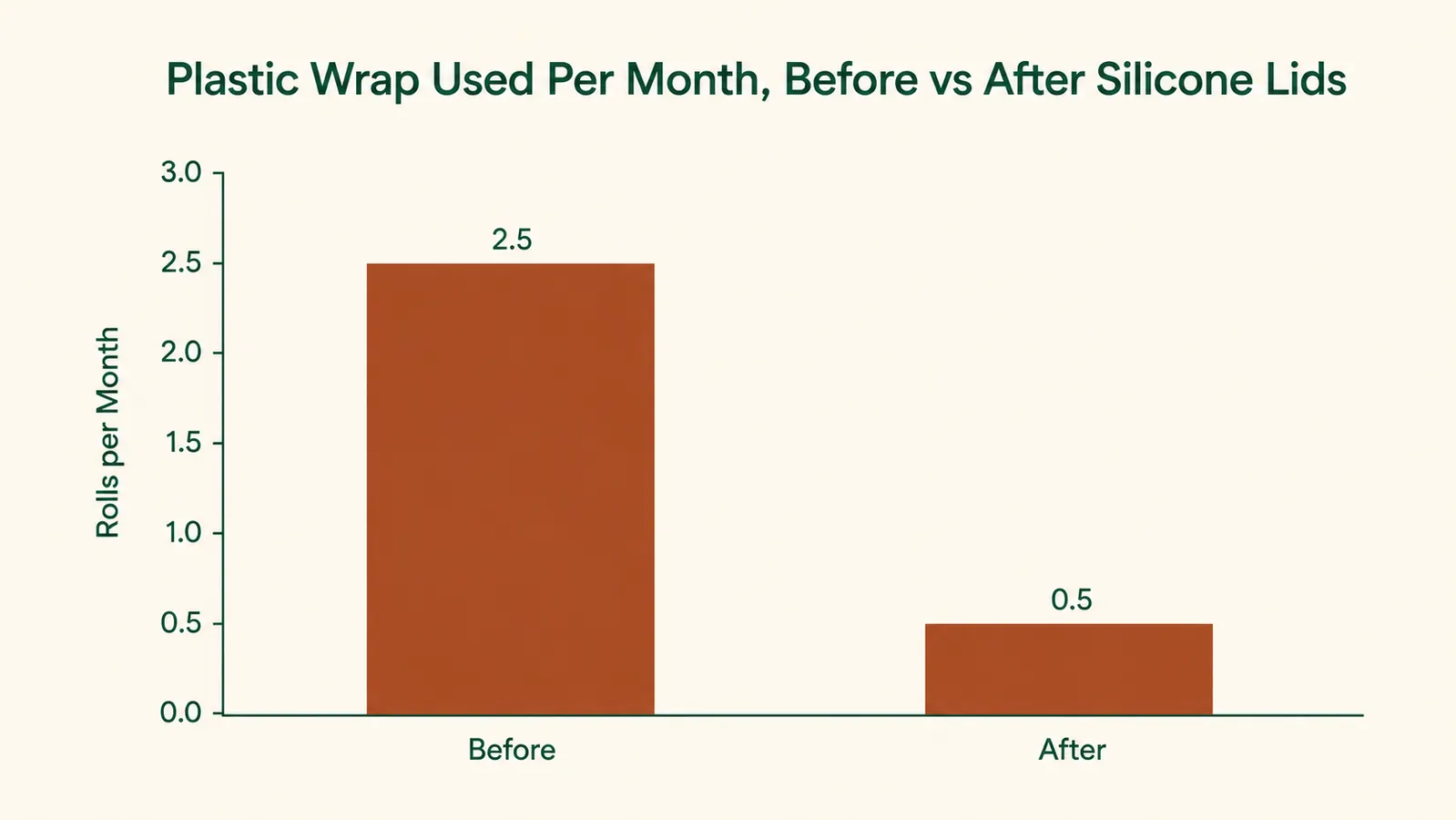
A year in, I still have all eight lids. None have torn, none have gone stiff, and I've thrown away exactly one roll of plastic wrap since, mostly because it came free with a grocery order and I felt bad tossing it unopened. This isn't a first-impressions review written a week after unboxing. It's what I actually noticed after a full four seasons of everyday use, including the two weeks a set like this gets tested hardest, the holidays, when the fridge is packed with more covered bowls than usual.
The Quick Verdict
A genuinely useful swap for plastic wrap on bowls, plates, and pots, though the smallest lid gets more use than the two largest ones combined.
Amazon Check Today's Price →The Set That's Actually Cut My Plastic Wrap Use to Almost Zero
Six sizes, one box, and a seal that's held up through a year of daily leftovers. See current availability and pricing on Amazon.
Amazon Check Today's Price on Amazon →How I've Used It
I didn't set out to write a year-long review of a box of silicone lids. I set them out on the counter the first week, used the two smallest ones on coffee mugs and a bowl of dip, and more or less forgot they were a new thing in my kitchen. That's the honest test, whether something earns a permanent spot or slides to the back of a drawer. These didn't slide anywhere. They live in a shallow drawer next to the cutting boards, and I reach into it multiple times a day, usually without thinking about it, which is a better sign than any five-star rating.
The set has six sizes, roughly 2.5, 4, 5.5, 6.5, 7.5, and 8.5 inches across, with two duplicates so you get eight lids total. I've used every size at least once, but three of them do almost all the work. If you're comparing this to the older habit of tearing off sheets, I laid out the full breakdown in silicone lids vs plastic wrap, but the short version is that the lids win on anything round and lose a little ground on odd shapes like a rectangular casserole dish or a baking sheet.
The way I actually use the GUANCI lids: the small lid goes on coffee mugs I'm saving for later and on the little glass ramekins I keep minced garlic and ginger in. The mid sizes cover cereal bowls, a pint of cut strawberries, and the bowl I mix pancake batter in when my daughter wants breakfast for dinner. The two largest lids are for the stockpot after I make soup and for the 9x13 casserole dish, though I'll admit the casserole dish is a stretch fit and I don't always trust it not to pop off in transit. Over a full year, I'd guess the two smallest sizes account for maybe sixty percent of total use, just because small bowls of leftovers happen far more often in this house than a full pot needing to be covered.
The Seal, Six Months and Twelve Months In
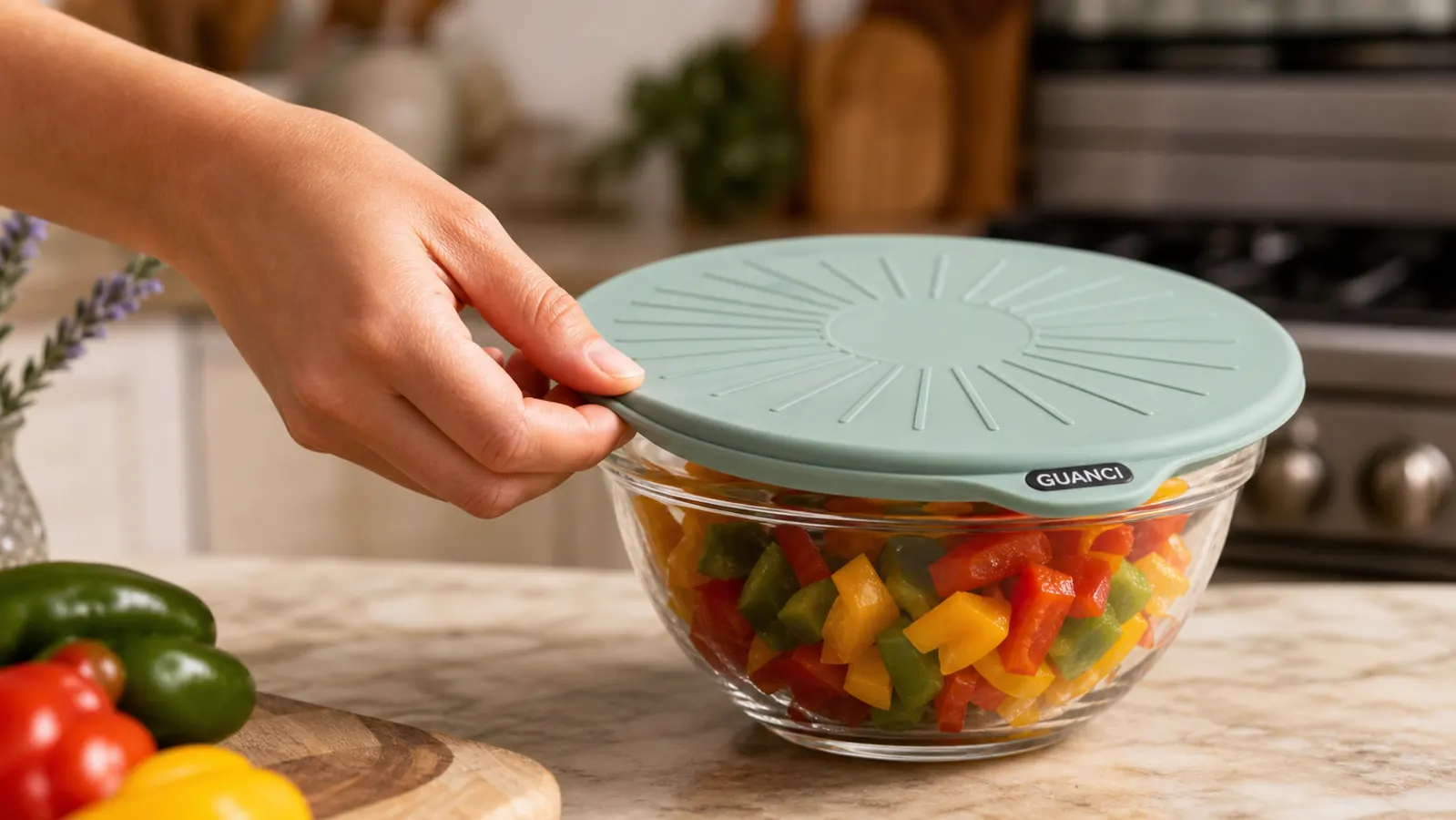
The reason silicone lids work at all is the seal, a raised lip on the underside that grips the rim of a bowl or pot and holds under light suction. When these arrived, the seal on every size was tight enough that I could pick up a full bowl of soup by the lid alone, which I do not recommend trying but did test once over the sink, mostly out of curiosity about how much confidence to put in them.
Twelve months later, that grip has softened slightly on the two lids I use daily, the 4-inch and the 5.5-inch. They still hold, but I've noticed the edges don't snap down with quite the same tension, and on a bowl with a slightly chipped or uneven rim, I sometimes have to press around the full circle twice to get a clean seal. The lids I use once a week or less, the smallest and the two largest, still feel exactly like they did the day I opened the box. That gap between the heavily used lids and the rarely used ones tells me the wear is coming from repeated stretching and release, not from age or exposure to heat and cold on its own.
None of the eight lids have torn, cracked, or developed a permanent warp. I've stretched them over bowls with a wider lip than they were sized for more than a few times, which the packaging doesn't exactly recommend, and the silicone has always sprung back to its original shape once I took it off. That elasticity holding up over a full year, through a few hundred stretch-and-release cycles, is the single most reassuring thing about this set.
Heat, Freezer, and the Microwave
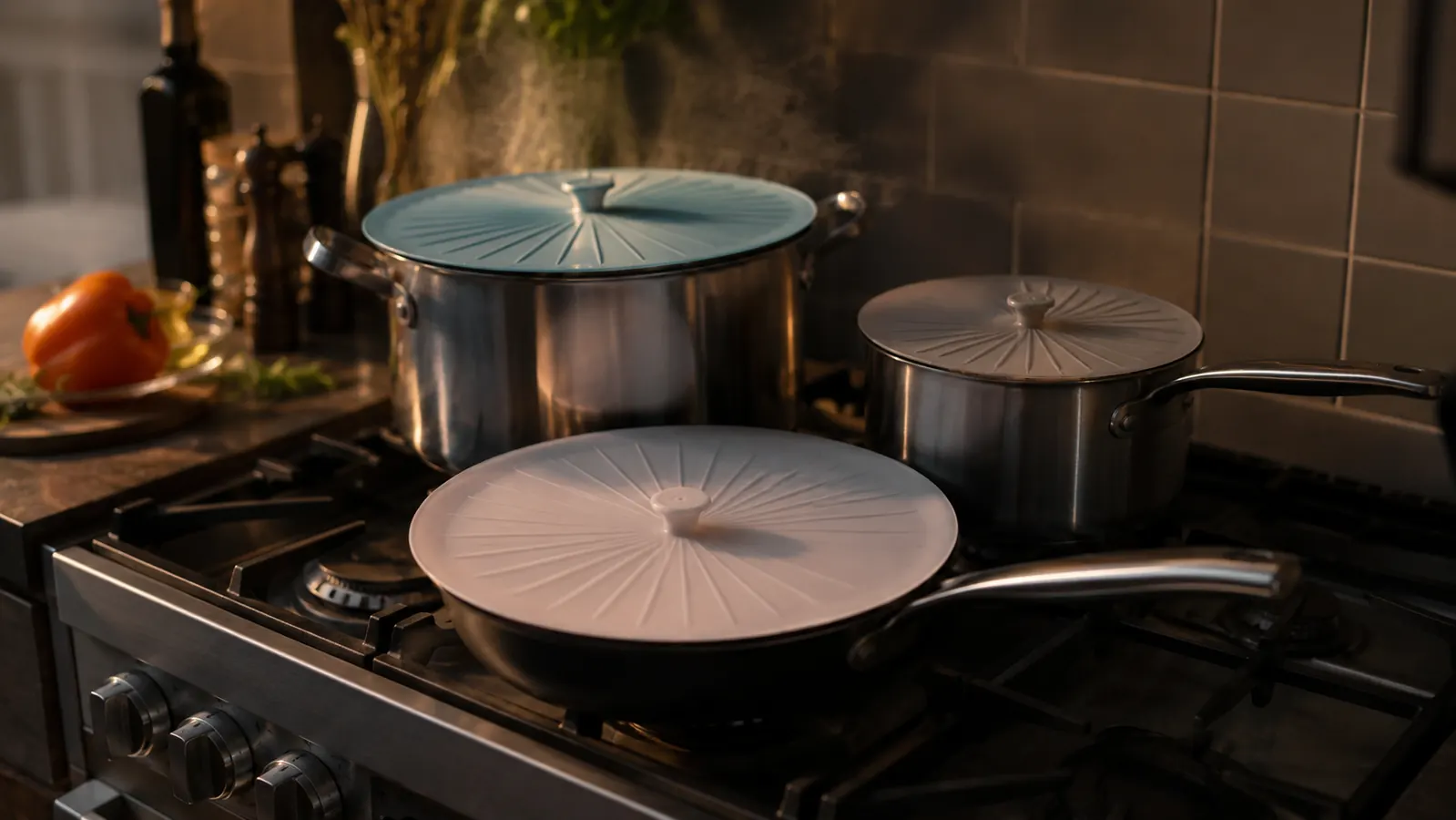
GUANCI markets these as microwave, oven, fridge, and freezer safe, and I've used them in three of those four ways regularly. Microwave use is where I reach for them most. Instead of a paper towel over a bowl of leftover pasta, I stretch a lid over it, and it stops splatter completely while venting a little steam at the edges so nothing builds up pressure. I've never had one balloon or pop off in the microwave, even reheating a bowl of chili for four minutes on a weeknight when I'm not paying close attention.
Fridge storage is the daily use case, and it's where these have replaced plastic wrap almost entirely. Freezer use is where I've been more cautious. I did freeze a container of soup under one of the mid-size lids for about three weeks, and it held its seal the whole time, but I noticed the silicone gets noticeably stiffer at freezer temperature, which makes it harder to pull off cleanly without warming it in your hands first. I haven't tried these directly in the oven, partly because I don't often need to keep a bowl covered while it bakes, so I can't speak to that use case from firsthand experience, and I'd rather say that plainly than guess.
Cleaning and the Dishwasher Question
These are listed as dishwasher safe, and I've run all eight through the top rack more times than I can count, usually clipped upright in the utensil basket so they don't nest inside each other and trap water. They come out clean, and I haven't seen any cloudiness or degradation in the silicone from repeated dishwasher cycles. On the rare occasion something greasy gets trapped in the seal groove on the underside, a quick pass with an old toothbrush under running water handles it faster than the dishwasher does anyway.
Where they show wear is staining. Tomato-based sauces, curry, and turmeric have all left a faint orange or red tint on the lids I use most, even after a full dishwasher cycle. It's cosmetic, not a hygiene issue, the lids still feel clean and don't hold odor, but if you're someone who likes kitchen tools to look brand new, know that the lighter-colored lids in a multi-color set will show this faster than a solid dark color would. My darkest lid, a deep green, still looks close to new. My lightest one, a pale blue, has a permanent faint orange ring from chili that no amount of baking soda has fully lifted.
What I Liked
- Genuinely replaces plastic wrap for most bowl and plate storage
- Six sizes cover nearly everything in a standard kitchen
- Vents steam safely in the microwave without splatter
- Dishwasher safe and easy to clean day to day
- No torn or cracked lids after a full year of regular use
Where It Falls Short
- Seal loosens slightly on the most-used sizes over time
- Light-colored lids stain from tomato sauce and turmeric
- Silicone stiffens in the freezer, harder to peel off cold
- Largest lid is a loose fit on anything wider than a standard mixing bowl
- Not a true airtight seal, not a replacement for freezer bags on liquids
I haven't bought a second roll of plastic wrap in eleven months, and that's the whole review in one sentence.
Where the Seal Isn't Airtight
I want to be specific about what the GUANCI lids are not, because I see reviews online treating silicone lids like a vacuum seal, and they aren't. The seal is a friction and suction fit against the rim, good enough to keep a bowl of cut fruit from drying out in the fridge for three or four days, not good enough to keep a bowl of soup from leaking if you tip it sideways. I learned this the annoying way, carrying a covered bowl of broth to the car for a potluck and cornering too fast in the driveway. The lid held for normal handling, upright in a fridge or on a counter, and that's the standard I'd judge it against, not the standard of something meant to travel.
If you're weighing these against a full switch away from single-use wrap, I go through the food waste angle in more detail in 10 reasons silicone lids cut food waste, since the bigger savings for us wasn't the plastic wrap itself, it was that a properly sealed bowl actually gets eaten instead of forgotten and pushed to the back of the shelf where plastic wrap had already come loose. A bowl that looks sealed and stays sealed gets opened again in two days. A bowl with a corner of wrap peeling off tends to get pushed back and forgotten.
Who This Is For
If your fridge is full of half-used bowls, cut produce, or leftover portions from cooking for a family, these earn their spot fast. Anyone who's tired of the plastic wrap ritual, the tearing, the sticking to itself, the running out at the worst moment, will notice the difference within the first week. They're also genuinely good for covering bowls in the microwave, which ended up being a use case I didn't expect to lean on as much as I do, and for anyone trying to cut down on single-use plastic without switching their whole storage system to hard containers.
It's also a good fit if you meal prep on Sundays the way I try to, and mostly fail, to keep up with during the week. Covering four or five prepped bowls of chopped vegetables, cooked rice, and marinating chicken used to mean either a stack of mismatched containers with lids that never matched the base, or an entire roll of plastic wrap gone by Tuesday. Now it's whatever bowl is already clean, plus a lid from the drawer, and everything nests in the fridge without the container-lid matching game.
Who Should Skip It
If most of what you cover is liquid you need to transport, soup you're taking to a friend's house, a marinade you're carrying to a cookout, these aren't a true replacement for a lidded container. And if you cook mostly for one and rarely have leftovers to store, an 8-piece set is more than you'll use, a smaller 3 or 4 piece set would cover the same ground without the two largest lids sitting unused in a drawer for months at a time.
They're also not the right pick if you're storing anything with a strong, lingering smell, think raw onion or fish marinade, on a regular basis. Silicone is more porous than glass or hard plastic, and while a run through the dishwasher clears most odor, I've noticed a faint garlic smell linger on one lid longer than I expected. For everyday leftovers and produce, that's a non-issue. For someone who stores pungent ingredients often, a dedicated glass container with a separate lid might serve you better.
A Year Later, This Is Still the First Thing I Reach For
If plastic wrap is a recurring annoyance in your kitchen, this is the swap that actually stuck for us. Check today's price and current availability.
Amazon Check Today's Price on Amazon →